

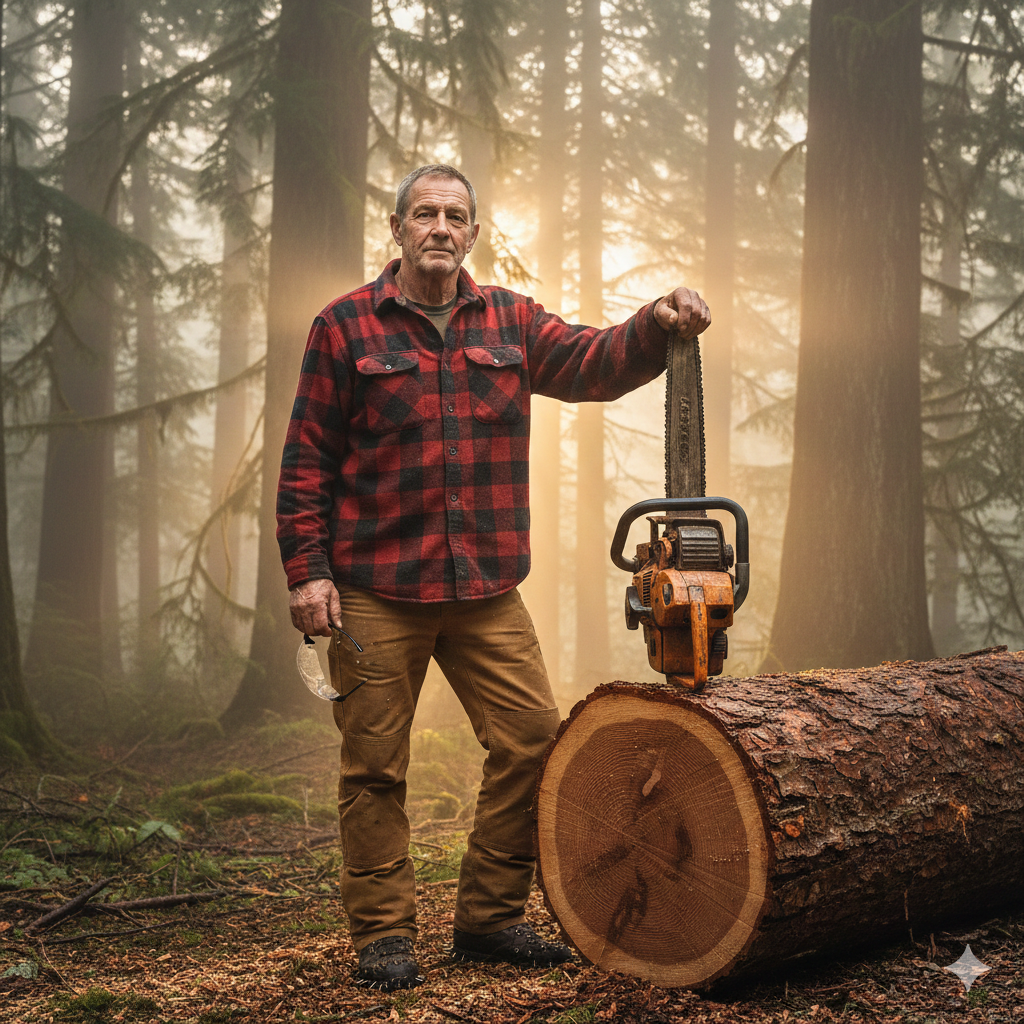
Let’s not get too wrapped up in the cartoonish image of the lumberjack in flannel and an oversized axe who is too fond of pancakes. The lumberjack story is one of deep forests, skills that very few possess, and a challenging, often misunderstood connection to a nation’s long, deep history of forests. A story that not only portrays the wood chips and the forests, but also the fingerprint of a nation’s high-tech, sustainable crafts. This article strips away the layers of fiction in folklore and reveals 10 truths about what it is like to be a lumberjack today.
Table of Contents
1. From Axe to Chainsaw: The Evolution of the Lumberjack
The history of the lumberjack is the history of human industry. The first woodcutters were often known as ‘shanty boys or timber beasts’. They worked using only human and animal power. The industry used a double-bitted axe and a misery whip, which is a two-person crosscut saw. Life in the logging camps was harsh, isolated, and brutal, and gave rise to the legendary folk attributes of lumberjack culture. Real innovation occurred with the introduction of mechanization. Automating with the chainsaw in the 20th century increased productivity tremendously and significantly reduced effort. Today’s lumberjack uses advanced automation, including feller bunchers, skidders, and processors. However, classic lumberjack abilities, such as reading the grain, understanding tension, and assessing the wind and lean, are still necessary and will always remain. The contemporary lumberjack performs the duties of a technician or machine operator, in addition to being a traditional woodsman.
2. Today’s Modern Lumberjack Equipment: Much More Than an Axe
Although the axe remains a symbolic tool and serves practical purposes such as notching and limbing, a professional lumberjack carries an extensive toolkit, a testament to their specialized, versatile equipment.
Chainsaws: The cornerstone of the industry. Today’s chainsaws are designed to be robust, balanced, and vibration-reducing, with optimized chains for various tasks. Just as a violinist knows their violin, a lumberjack knows their saw.
Personal Protective Equipment (PPE): This is non-negotiable. A complete set includes:
- Chainsaw pants or chaps that are made with ballistic fibers that clog the saw chain.
- Steel-cut, deep tread (caulks) boots with a protective toe that is resistant to chainsaws. The tread is designed to grip logs.
- A hard hat with a face cover and ear protection attached.
- Clothing that has high visibility.
Specialized Equipment: Felling wedges, various axes (such as falling, splitting, and fire axes), timber tongs, and complex pull rigging systems are a few examples of what a logger might need. Loggers may also use compasses, logging software, and specialized ruggedized tablets.
3. The Anatomy of a Fall: Precision in Every Cut
From the outside, felling a tree may look like a lot of chopping. In reality, to be a head feller requires a lot of skill. Every cut and decision a lumberjack makes is a part of a delicate, multipart process.
The Hazard Assessment: Before a logger decides to take down a tree, they consider several factors. The tree’s lean direction, the weight distribution on the tree, the direction of wind, the possibility of dead branches (widowmakers), and the best escape route.
The Notch: This refers to a V-shaped cut made on the tree side it is planned to fall towards. The notch is supposed to direct a tree where it is supposed to drop.
On the tree side opposite where it is supposed to fall, a cut is made (also called the back cut), leaving an uncut “Hinge” section. This section controls the tree’s fall so that a skilled logger can steer it towards something.
The Escape: Once the tree is guaranteed to fall, the logger needs to escape along the route they planned. From the stump, it is a long way back, so they cannot be left with a glance.
4. A Day in the Life: It’s Not Just Swinging Steel
A lumberjack’s life isn’t all about romance novel-type felling. It is a highly diverse and demanding trade. A day in the life of a sustainable logging show would entail:
- Starting the day pre-dawn, examining gear and the day’s weather.
- Conducting a crew safety meeting (JSA – Job Safety Analysis).
- Cutting down trees marked by a forest ranger for timbering.
- Limbing: the removal of all the branches from a downed trunk.
- Bucking: sectioning the trunk into specified lengths (logs) that can be transported.
- Driving or assisting in the operation of skidders that lower the logs to a landing.
Tool and machine maintenance is a constant. A serious lumberjack does a final ritual of cleaning and sharpening saws at the end of every shift.
5. The Unbreakable Code: Safety as a First Language
The woods are a workplace like none other, and one mistake can be fatal. Safety is not a rulebook; it’s a culture, a language that every veteran logger speaks. This culture incorporates:
- The 150% Rule: Always be aware of yourself, your saw, the tree, and everything that is within 150% of the height of the tree.
- Communication: Constant, clear signals; spotters; and crewmates’ check-ins.
- Respect for Fatigue: An experienced lumberjack knows when to call it a day. He knows that a fatigued lumberjack is a dangerous lumberjack.
- Scenario Planning: Good lumberjacks don’t wait to answer the questions “What if?” They don’t wait for the wind shifts or wait for the bar to pinch. They know what to do.
6. Sustainable Forestry: The Lumberjack as a Steward
This is the most important evolution of the craft. The modern lumberjack works within the bounds of science-based forest management. The “cut and run” approach is a thing of the past. Forestry today involves:
- Implementation of a forest management plan developed by a professional forester.
- Selective cutting of over-mature trees, leaving behind the healthiest ones to reseed and younger trees to grow.
- Riparian protection of waterways allows forests to undergo natural succession.
- Soil disturbance is to be avoided to allow for the natural regeneration of the forest.
This lumberjack knows that the health of the forest is everything for the economic viability of the next generation. He is a harvester and a cultivator.
7. The Physical and Mental Grit Required
A logger’s job is very physically taxing. There is extreme stamina needed to complete ten-hour shifts in all weather, along with the persistence to pick up and maneuver heavy equipment and logs. Lastly, the job requires extreme caution when traversing and maintaining balance on uneven, treacherous surfaces. Furthermore, mental strength is just as critical.
There is constant danger while lumberjacking and working among giant, loud machines. Surpassing these obstacles requires extraordinary and acute focus. There is also a need for high-end problem-solving and awareness skills, as trees can often present unforeseen obstacles, such as a hung tree or a pinched saw. The logger must also be patient enough never to rush an individual cut. The psychological stamina of a logger working in remote, often isolated conditions is also extreme. All of these skills and enduring traits are characteristic of a professional logger.
8. Lumberjack Culture and Community
There is still a culture from the old logging camps: self-reliance, dark humor, and quiet confidence. Logging as a way of life also extends this culture into the communities surrounding the woods. Lumberjack sports, with competitions in chopping, sawing, and even log rolling, celebrate that heritage. These skills are no longer needed on the job, but they are still performed, keeping the connection to the old camps. The crew becomes like a family, and they need that closeness for their own safety.
9. Women in the Timber: Breaking the Bark Barrier
Women now participate in the logging industry alongside men, with many beginning careers as professional fallers, equipment operators, and foresters. Women also possess the necessary skills, strength, and respect required for these positions. There is a shift toward using the term ‘lumberjack’ as a gender-neutral title for professional logging skills, regardless of the individual’s gender. The industry is seeing radical changes due to these professionals logging women.
10. The Future of the Lumberjack Trade
Tomorrow’s arborist will be more tech savvy than ever and will likely have tools such as drones for aerial surveying, GPS to the trees for precise timber mapping, and automated computers to assist with cutting. The need for sustainability will be stronger than ever as the public grows concerned and demands certified wood products. The profession will still need someone to understand the trees, respect the danger, and possess the skill of the cut, as the lumberjack will once again be the only vital contact with the endless resource of trees for the people.
While the stories about loggers are numerous and powerful, the truth is more intriguing. It is a career that combines ancient wisdom and modern science, along with raw power and delicate precision. It is a life chosen by people who find purpose outside the office, in the quiet, cathedral-like, and demanding environment of the woods. To understand the lumberjack is to understand a deep, respectful, and enduring relationship with the world around us.
You may also read itbigbash.