Table of Contents
Beer is a strange drink, and many people may understand how weird it is when they hand someone a drink for the first time, and it’s a contortion. Asking what beer tastes like in the first place is a super fair question, especially when it comes to beer menus that are over 30 beers long. Simply stating that it tastes like beer is an outrageous understatement. Closely walking into a craft brewery and saying that food tastes like food is idiotic.
There are many, many, many flavours that beers can present. Some beers are light and easy, like a sip of sunshine, and others are heavier, like a stout with chocolate and coffee, or a sour that will pop your taste buds. What does beer taste like? It’s not a single note, it’s a symphony.
Beer is made from four ingredients: water, yeast, malt, and hops. Those four ingredients work together to create a masterpiece. This guide breaks down the different elements of the taste so you can genuinely enjoy the beer. It’s not about elitism; it’s about a roadmap. We will uncover the 10 taste categories and explain how each ingredient imparts flavour so that you can enjoy the whole beer experience, not just down it mindlessly.
Four Pillars of Flavour: Your Brewing Toolkit
Before we explore the realm of taste, it’s essential to understand which ingredients create the different flavours. What you find in your brew will come from one of the four ingredients.
Malt: The Sweet Soul
This is one of the ingredients: fermented barley. It gives the beer a backbone. It provides the sugars that yeast will ferment into alcohol, but it also provides flavours. Different types of malts can contribute different flavour profiles.
A lightly malted brew will be sweet, with hints of bread and other notes reminiscent of a bread crust. A brew made from heavily malted barley will have flavours of caramel, toffee, nuts, and even bitter dark chocolate.
Hops: The Spicy, Bitter Heart
These green, pinecone-shaped flowers provide balance to the sweetness that malts bring. They add a great variety of aromas and flavours. Depending on the type, hops bring notes of citrus, pine, resin, flowers, tropical fruits, or herbs, and a touch of bitterness that creates a clean, dry feel on the back of your tongue.
Yeast: The Mysterious Alchemist
These microorganisms eat sugars and create alcohol and carbon dioxide as byproducts. But some yeast strains also produce a wide array of additional flavours. These extra flavours can be pleasant and neutral, making the malts and hops stand out, or they can be spicy and fruity (banana, plum, apple), or even funky and earthy.
Water: The Silent Canvas
Over 90% of your beer is made of water, and the minerals (soft or hard) can emphasise the bitterness of the hops, the sweetness of the malts, or create a crisp or silky feel on the tongue.
Understanding how roast malt creates chocolate flavours and how citrus hops add complexity to a beer’s flavours is invaluable. The essence of the question is, what does beer taste like? If you were to ask yourself the question, you could describe beer in 10 distinct ways from a flavour profile perspective, and in the following excerpt, I’ll share each of the 10 different flavour profiles.
1. Crisp & Clean: The Refreshing Baseline
In the example scenario, some beers are crisp and clean, which serves as a refreshing baseline. For many, refreshing is the very first flavour that comes to mind when they think of a beer.
With these flavour profiles, you’ll find they align with beers that provide a refreshing sensation, including popular American lagers, pilsners, and helles. Some of the flavours you’ll find are light, crispy, and clean, with notes of grain and a floral complexion. The carbonation is high, and they are incredibly light and thirst-quenching.
2. Malty & Sweet: Comfort in a Glass
The malt flavour of the beer is a comforting embrace and is also prominent in Maerzen, amber, and Scottish ales. In these beers, there are also notes of caramel, toffee, and bread.
Mouthfeel: It can be smooth with medium body and lower carbonation. It has a reassuring and comforting presence.
Think: liquid caramel, the covered bread, or the brown edges of a perfectly crafted pie crust.
3. Bitter & Hoppy: The Modern Powerhouse
Pale ales and IPAs lead this blend and are highly explored. It is a direct observation of hop characteristics.
Primary Flavours: The bitterness is clean, with a back-tongue hit. The aroma and pine wood are long, resinous, even in the most classic of West Coast IPAs, with the addition of grapefruit. It contains orange, watermelon, and passion fruit with New England- or hazy-style IPAs.
Mouthfeel: Dry and crisp to juicy and soft.
Think: A grapefruit wedge with a sprinkle of pine or a tropical bitter spine fruit salad.
4. Dark & Roasty: The Campfire in a Glass
Black, White, and Brown porters and stouts exemplify the works of the deeply roasted malts.
Primary Flavours: Charred wood, dark chocolate, coffee or espresso, and a touch of liquorice. sweet can be creamy and unstinting. (Milk Stout) It can also be dry (Irish stout)
Mouthfeel: They have a full-bodied feel and a creamy or silky texture. The carbonation is typically on the lower end.
5. Fruity & Spicy: The Yeast’s Show
Belgian and German wheat beers (Hefeweizens, Belgian Tripels, Saisons) are famous for this, where yeast-driven flavours overshadow hops.
Primary: banana, clove, bubblegum, pear, apple, black pepper, and bready, hazy malt.
Texture: effervescent, high carbonation. ends dry.
Think: Spicy banana bread.
6. Sour & Tangy: The Pucker Factor
A rapidly growing category of beers: Berliner Weiss, Gose, and Lambics. The Pucker Factor is another large category of beers that are Tangy, sour, and complex, exhibiting high levels of sourness; typically, they are made with wild yeast or bacteria.
Primary Flavours: A clean and crisp acidity that is akin to that of lemons, green apples, or yoghurt. Some have fruity additions (cherry, raspberry) while others are funky and earthy.
A dry, effervescent mouthfeel that leaves you wanting another sip. High carbonation.
Think: Sour Warhead candy. A drink of liquid candy that expresses the needs of high acidity & pairs very well. Little Warhead candy to hold you over.
7. Funky & Wild: The Cult Favourite
Primary Flavours: Earthiness, barnyard, leather, horse blanket, and overripe fruit, with a complex dry sourness that develops appreciation but is really a cult favourite.
Mouthfeel: Bone dry and highly carbonated.
Think: A dry white wine and a funky cheese cellar. It’s a challenge.
8. Smoky: The Ancient Echo
German Rauchbier and other styles use malt smoked over beechwood fires.
Primary Flavours: Campfire, smoked ham, and bacon. A balancing malt is sweetness, char, and ash.
Mouthfeel: Smooth and medium-bodied.
Think: Drinking a cold, delicious campfire. It’s directly linked to the ancient past of brewing.
9. Strong & Boozy: The Sipping Experience
This covers the Barleywines, Imperial Stouts, and Belgian Quadrupels. High alcohol is a key flavour.
Primary Flavours: Dark fruit (like prune, fig, raisin) and a warming alcohol. It’s complex and king.
Mouthfeel: Rich and full-bodied. It’s meant to be sipped, often low in carbonation.
Think: A Sherry or port that decided to be a beer, somehow becoming a nightcap and a dessert.
10. Juicy & Hazy: The Modern Phenomenon
The New England IPA (NEIPA) is a unique style deserving its own category.
Can you see that Hazy IPAs have layers? The primary flavours of Hazy IPAs are massive, juicy fruit layers of orange juice, peach, passionfruit, and mango, with low perceived bitterness. Hazy IPAs often have a cloudy look.
The mouthfeel of a Hazy Cup is uniquely soft, smooth, and almost creamy. The carbonation is lower, and their texture is similar to fruit nectar.
Hazy IPAs have lots of juicy tropical fruit flavours and are purposely made to have a smoothie-like mouthfeel. They are also meant to be approachable.
How to Actually Taste Beer: A Practical Guide
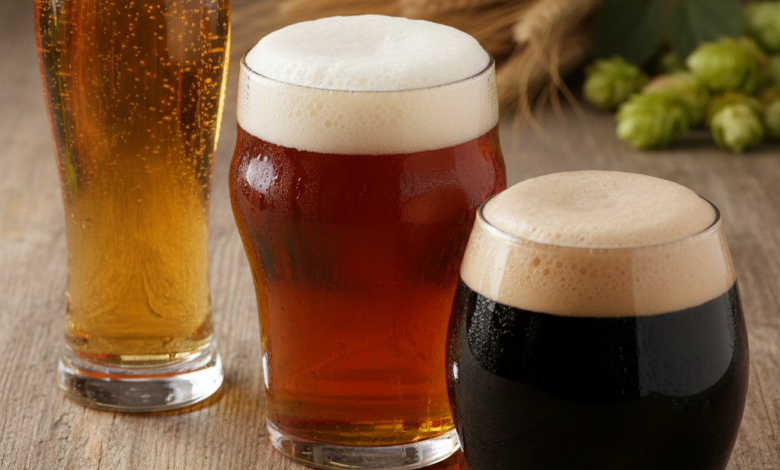
- Look: Look at its colour. Is it happy gold or black as obsidian? Is it hazy or clear? Is it straw gold or black as obsidian? What colour is the foam? Is it golden, black, creamy, or frothy?
- Smell: Gently swirl the beer and take a deep snuff. Your nose detests 80% of the flavour. Which do you sense more: hops or malt? What fruit and spices do you smell?
- Sip: Medium and a sip. Let the beer sit on top of the tongue. What do you sense more? The malt (1st), hops (middle), or the finish (the aftertaste. Is it bitter, sweet, or dry?
- Feel: Focus on weight and carbonation. Is it light and twinkly or heavy and flat?
- Think: This is the most important one. What did it remind you of? Don’t worry about being “right.” If that stout tastes like your grandma’s cake to you, that’s worth something.
Conclusion: Your Journey, Your Pint
So what does beer taste like? After this, it should be clear that it can taste a million different ways. The taste of beer can be complex or straightforward, refreshing or even adventurous. The taste of beer is subjective, and there are a million correct answers.
The only way to know what beer tastes like is to go out and taste it yourself. Try different kinds and share with friends. Your tastebuds are all you need. There is so much out there, and you are not limited to one thing. Enjoy the journey.
You may also read itbigbash.

