
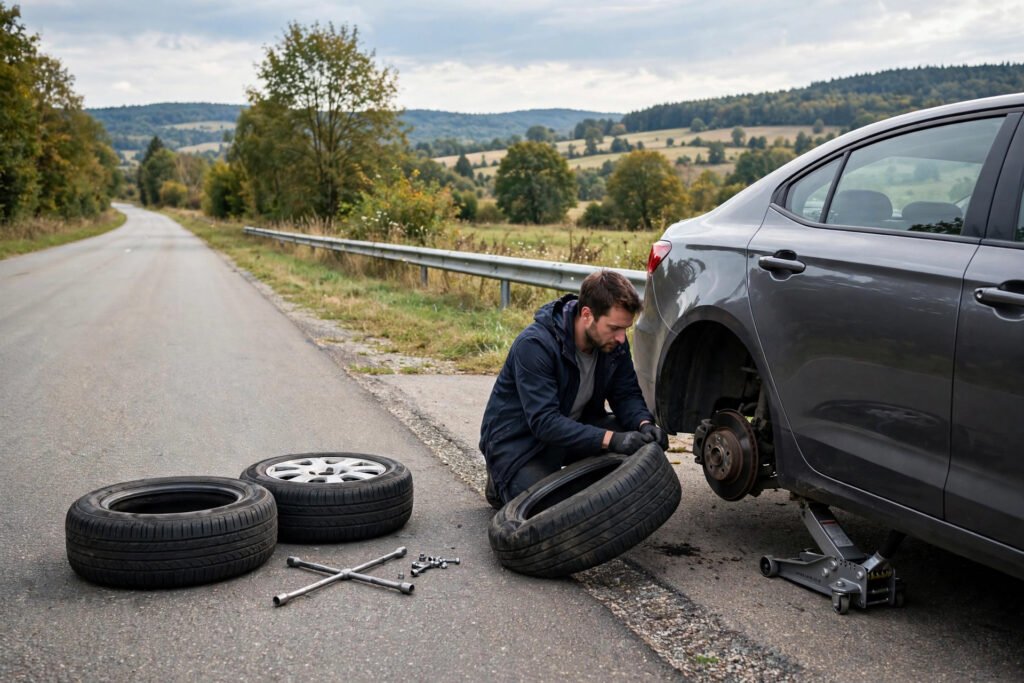
How to Change a Tire: A Complete Step-by-Step Guide
A flat tire has a way of showing up at the worst possible moment: a dark country road, a packed motorway shoulder, a rainy Tuesday when you’re already late. The good news is that learning how to change a tire is one of the most practical skills a driver can have. With the spare, jack, and lug wrench your car already carries, most people can swap a flat for a spare in about 20 to 30 minutes, and this guide walks you through the whole thing in order.
The short version: park on flat ground, apply the parking brake, loosen the lug nuts while the car is still on the ground, jack up the car at the reinforced jacking point, swap the flat for the spare, hand-tighten the nuts, lower the car, then tighten the nuts in a star pattern. Read on for the details that keep each step safe and trouble-free.
How to Change a Tire: The Short Version
If you’re standing on the shoulder right now with the hazard lights flashing, here’s how to change a tire at a glance. Each step is explained fully below.
- Pull onto flat, firm ground away from traffic. Hazards on, parking brake set, engine in Park (or reverse in a manual).
- Get everyone out of the car and standing away from the road. Block a wheel so the car can’t roll.
- Find the spare, jack, and lug wrench (usually under the boot floor, or under the rear on some SUVs).
- Loosen each lug nut a quarter-turn counter-clockwise before lifting the car.
- Place the jack under the car’s designated jacking point and raise it until the flat tire clears the ground.
- Remove the lug nuts completely, pull the flat tire off, and slide it under the car as a backup support.
- Push the spare onto the wheel studs and hand-tighten every lug nut in a star pattern.
- Lower the car until the tire touches the ground and takes some weight, then tighten the nuts firmly in the star pattern.
- Lower the car fully, remove the jack, and give the lug nuts one final star-pattern check.
- Stow everything, then drive straight to a tire shop. On a donut spare, keep it slow and short.
Get Somewhere Safe Before You Start
Knowing how to change a tire is only half the job; where you stop is the other half. If you can roll a few more yards on the flat to reach solid ground, do it — a ruined tire is cheaper than a ruined car or a serious injury. Aim for a parking lot, a side street, or a wide, flat shoulder well away from moving traffic. Soft grass, gravel, and slopes are bad surfaces for a jack: it can sink, tilt, or slip.
Once stopped: hazard lights on, parking brake pulled hard, transmission in Park (automatic) or reverse (manual). Everyone gets out and waits on the side away from the road, well behind the barrier or verge if there is one. If you have a wheel chock, wedge it against a wheel on the opposite end of the car from the flat; a heavy rock or a solid block of wood works in a pinch. If you carry a warning triangle, set it a good distance behind the car to give approaching drivers time to move over.
Gather Your Tire-Changing Tools
Almost every car comes with the basics, so start there. Under the boot floor (or beneath the rear of some trucks and SUVs) you should find a spare tire, a jack, and a lug wrench. Two problems catch people out here: they’ve never actually located the tools, and the spare has been sitting flat for years. Check the spare before you lift the car — if it has no air, you’ll want to know now, not after you’ve removed the good wheel.
A few extras make the job far easier and are worth keeping in the boot permanently: a proper 4-way lug wrench (the factory wrench is often short and flimsy), a flashlight or headlamp for night work, work gloves, a tire pressure gauge, and a cheap wheel chock. Gloves genuinely matter — lug nuts are filthy and sharp-edged things. If you want to upgrade one item, make it the wrench: a longer wrench gives you leverage, and leverage is the difference between a stuck nut and a smooth one. One calm practice session in your own driveway is the best way to learn how to change a tire without any pressure.
Loosen the Lug Nuts While the Car Is on the Ground

This is the step most beginners get backwards. Loosen the lug nuts before the car goes up on the jack, while the tire’s full weight holds the wheel still. Once the car is airborne, a loosened wheel spins freely and the jack takes dangerous side loads.
Fit the wrench fully onto the first nut so it sits square — a crooked wrench rounds the nut and creates a real problem. Turn counter-clockwise (lefty-loosey) about a quarter-turn: enough to break the nut free, not enough to remove it. Work through all of them. If a nut refuses to budge, seat the wrench carefully and press down with your foot on the end of the handle, leaning your weight into it smoothly rather than jumping on it. If your car uses locking wheel nuts, you’ll need the special key, which usually lives with the spare — no key, no tire change.
Jack Up the Car at the Right Spot
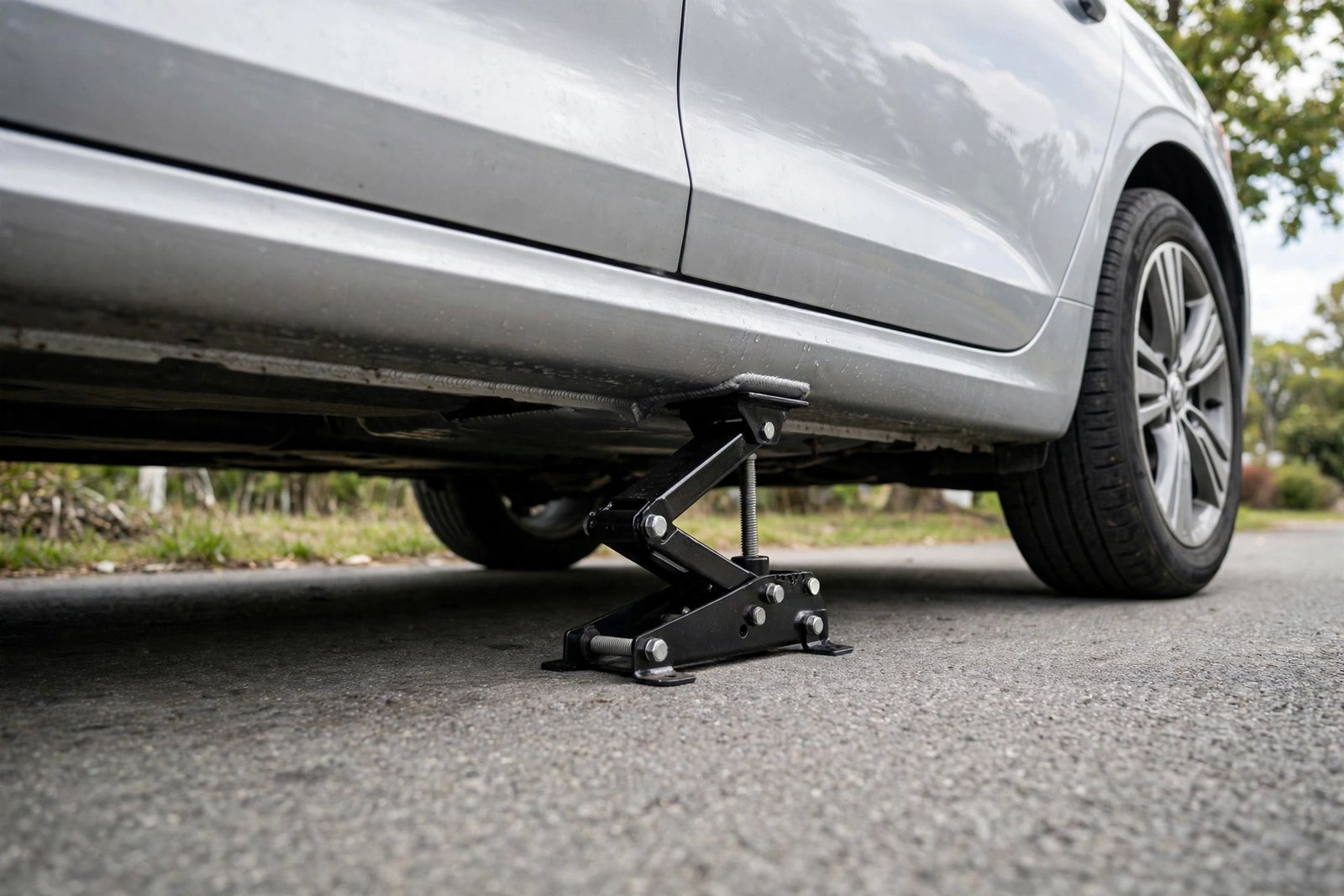
Your owner’s manual shows the approved jacking points, and this is one detail worth reading before you need it. Most cars have reinforced pinch welds or marked spots just behind the front wheels and ahead of the rear wheels — often indicated by a small notch or arrow on the rocker panel. Placing the jack anywhere else can crumple body panels, crack a plastic undertray, or let the car slip.
Set the jack on firm, level ground directly under the jacking point, keeping it vertical. On soft ground, put a flat board or a thick piece of wood under the jack so it can’t sink. Then raise the car slowly until the flat tire is a few inches off the ground — just enough clearance to pull the wheel off and slide the spare on. Never put any part of your body under a car that’s held up by a roadside jack alone. Before going further, give the car a gentle sideways nudge to confirm it’s stable on the jack.
Remove the Flat and Mount the Spare
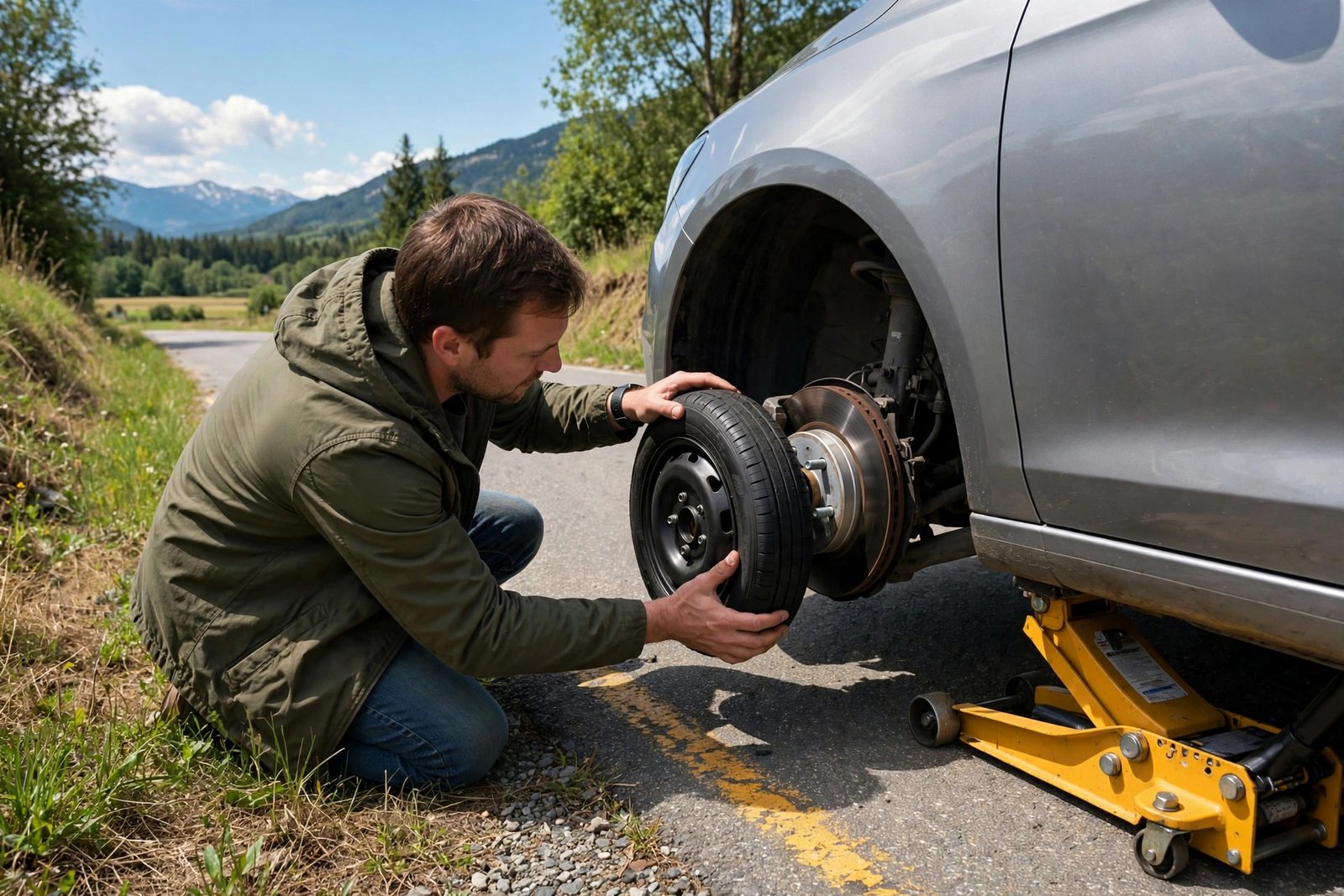
Finish unscrewing the loosened lug nuts and put them somewhere they can’t roll away — a pocket or the hubcap works. Then grip the flat tire at the 3 and 9 o’clock positions and pull it straight toward you. If it’s rusted onto the hub, a firm kick to the tire at the bottom with the sole of your shoe (alternating sides) usually breaks it free; keep your face clear of the wheel as you do.
Slide the flat tire under the car near the jacking point. It sounds odd, but it adds a backup support point if the jack ever slips. Now lift the spare, line up its holes with the wheel studs, and push it onto the hub until it sits completely flush — if it wobbles or stops short, pull it back off and realign it, because a wheel that doesn’t seat flat will never tighten correctly.
Thread each lug nut on by hand first, turning each one a few threads before snugging any of them down. Hand-threading first is what prevents cross-threading, the classic beginner mistake that damages the studs. Once every nut is on by a few threads, snug them in a star pattern (also called a cross pattern): tighten one nut, then the one opposite it across the wheel, and so on around the circle. This pulls the wheel onto the hub evenly instead of cocking it sideways.
Lower the Car and Tighten the Lug Nuts in a Star Pattern
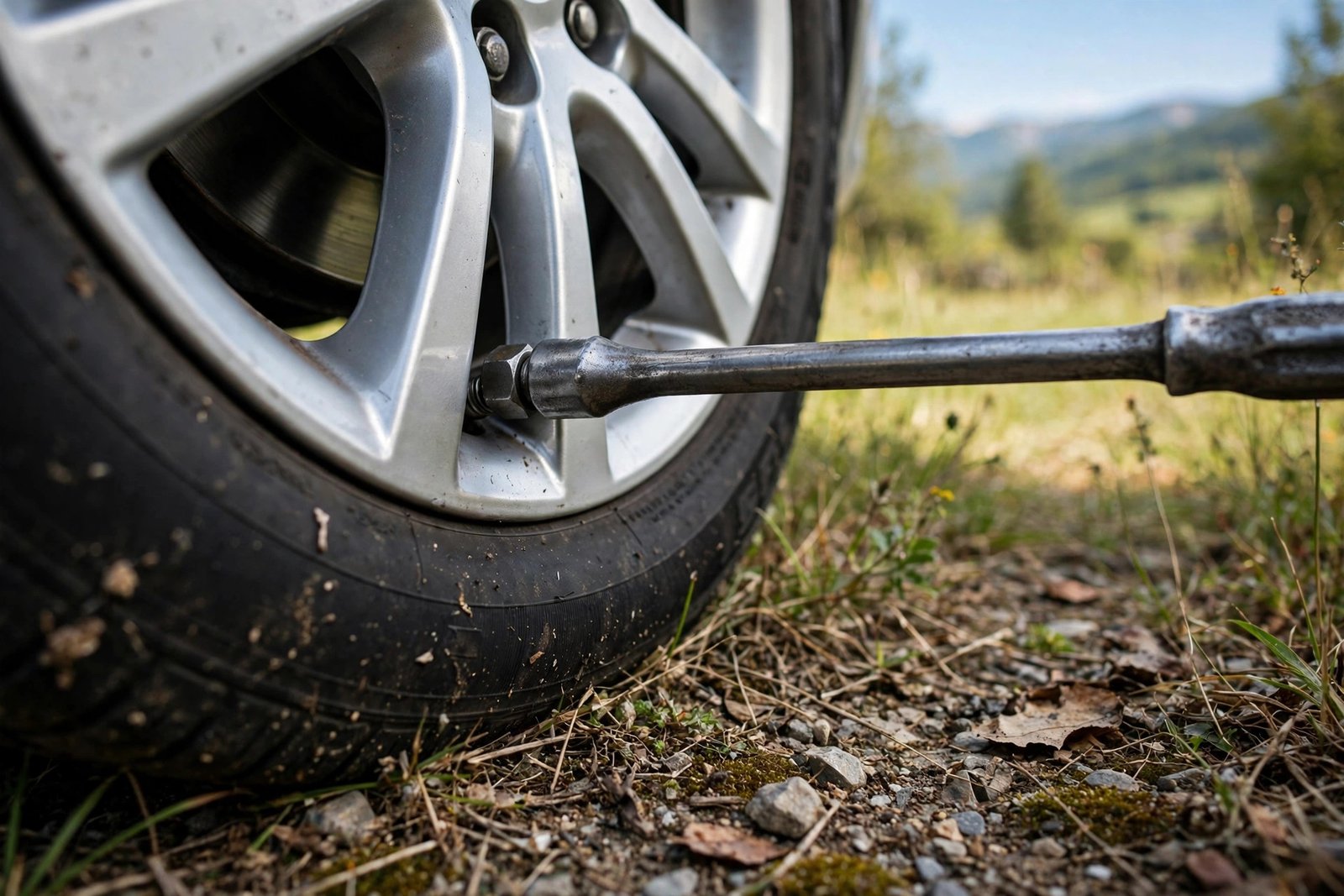
Lower the jack slowly until the spare touches the ground and takes some of the car’s weight — enough that the wheel can’t spin, but the jack is still supporting most of the load. Now tighten the lug nuts firmly with the wrench, again in the star pattern, going across the circle rather than around it.
Lower the car the rest of the way and pull the jack out. Then do one final star-pattern pass over the nuts. This last check catches any nut that settled as the wheel seated under full weight, and it’s the single most skipped step in the whole job. If your manual lists a torque specification and you own a torque wrench, use it: too loose and the wheel can work free; too tight and you stretch or snap the studs. Many garages also recommend re-checking the nuts after about 50 miles of driving, since a freshly mounted wheel can settle.
Driving on a Donut Spare: Follow the 50-50 Rule
Many cars carry a compact space-saver spare — the skinny “donut” that looks nothing like your other wheels. It’s a genuine lifeline, but it’s a temporary one with hard limits. The easy way to remember them is the 50-50 rule: no faster than 50 mph (80 km/h), no farther than about 50 miles (some manufacturers allow up to 70 — check the number printed on the spare’s sidewall). That limit exists because a donut has less grip, less heat capacity, and a different diameter than a normal tire; pushing it faster or farther risks a blowout or transmission stress, especially on a driven axle. If you have a choice, fitting the compact spare to a non-driven axle reduces strain on the drivetrain.
Two more donut quirks worth knowing. First, compact spares often need much higher pressure than normal tires — around 60 PSI is common — so check the stamped pressure and inflate it before you drive. Second, most donuts have no tire-pressure sensor, so don’t panic when the TPMS warning light comes on; that’s normal and it will clear once the full-size wheel is back on. Drive to a tire shop the same day, brake gently, and avoid sharp lane changes until the proper tire is refitted. Learn more about how a compact space-saver spare differs from a full-size wheel.
Mistakes That Turn a Tire Change Into a Tow Truck Call
Almost every roadside mishap from someone learning how to change a tire comes from the same short list. Loosening nuts after the car is already jacked up (the car can fall). Jacking on a slope or soft ground. Forgetting the parking brake so the car rolls. Cross-threading a lug nut by forcing it with the wrench instead of starting it by hand. And tightening the nuts in a circle instead of a star pattern, which seats the wheel crooked.
Two subtler ones: fitting a spare whose sidewall arrows point the wrong way on directional tires, and driving off on a donut without checking its pressure. Give the spare’s sidewall a quick look before you mount it — the arrows, pressure, and speed rating are all printed right there.
When to Skip the DIY and Call for Help
Knowing how to change a tire includes knowing when not to. If the shoulder is narrow with fast traffic inches away, if visibility is poor, if the ground is soft or sloped, or if it’s pouring rain and you have no safe working area, don’t risk it. A tow or roadside assistance call costs far less than a serious injury.
Similarly, if you find the spare is flat or missing, if the locking wheel nut key is gone, or if more than one tire is damaged, the DIY option is off the table. Keep your roadside assistance number in your phone — and if your policy doesn’t include it, that’s worth fixing before the next flat.
Simple Habits That Keep Your Tires Healthy
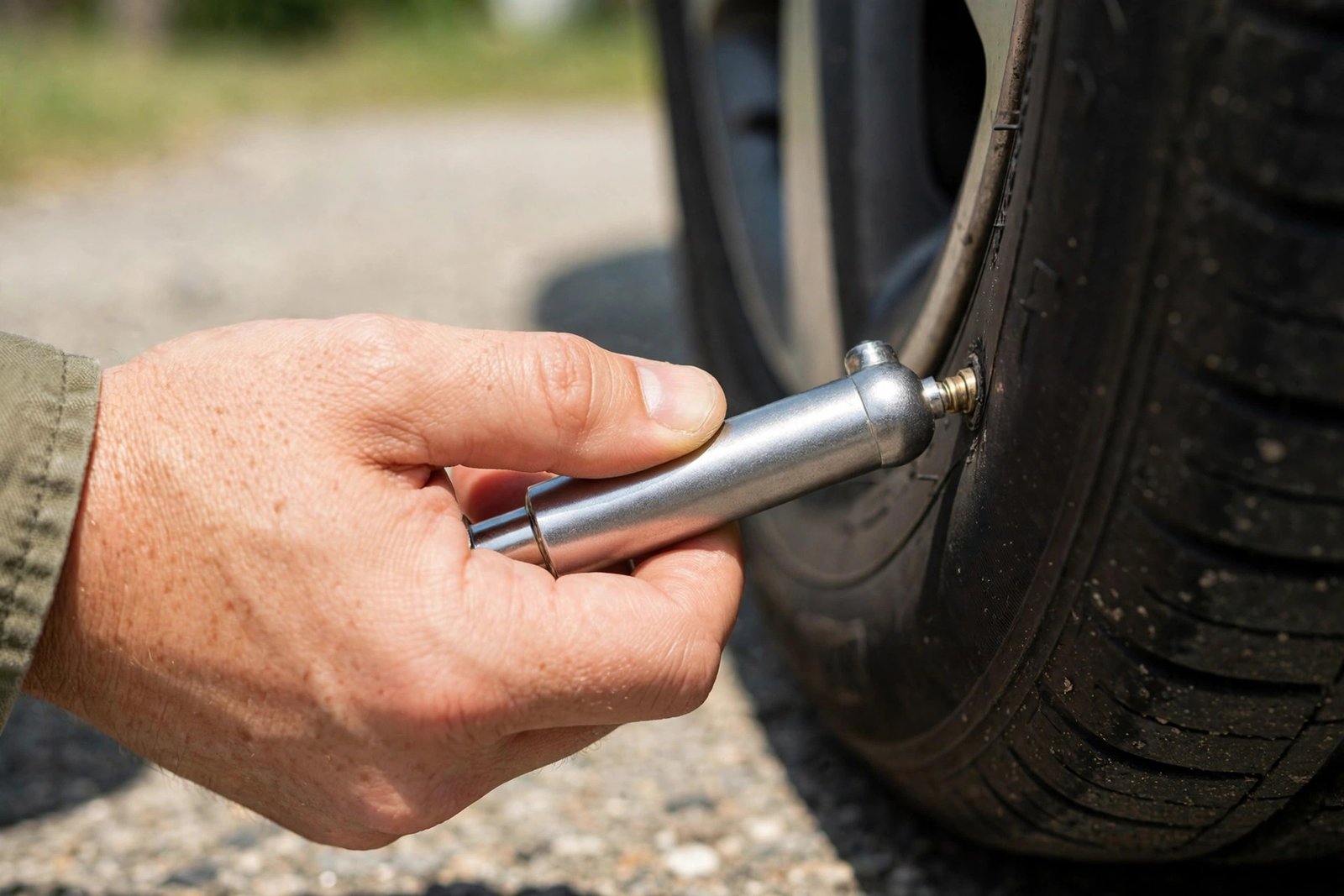
The best tire change is the one you never need. Check all five tires’ pressures once a month, including the spare — donuts slowly lose air in the boot, and a flat spare turns one problem into two. Use the pressure on the sticker inside the driver’s door jamb, not the maximum printed on the tire sidewall.
Keep an eye on tread depth: in the UK the legal minimum is 1.6mm across the central three-quarters of the tire, and a quick 20p-coin check works — push the coin into a tread groove, and if the coin’s outer band is fully visible, the tread is getting low. Uneven wear is a warning sign: get the alignment checked and keep up with regular tire rotation so all four tires wear evenly. Steer around potholes when you safely can, and take a look at your tires now and then for embedded nails, bulges, or sidewall cuts — catching those early is exactly what keeps small problems from becoming roadside ones. Car care goes beyond tires, too: learning how to check your transmission fluid is another five-minute habit that keeps a car healthy between services.
Frequently Asked Questions About How to Change a Tire
These are the questions people ask most about how to change a tire.
How long does it take to change a tire?
About 20 to 30 minutes for a first-timer who follows the steps calmly; around 10 to 15 minutes once you’ve done it before. If you’re rushing or improvising tools, expect longer.
Can I drive on a flat tire to reach a safer spot?
A very short distance at very low speed — just far enough to get off the road or onto flat ground. Every extra yard damages the tire and possibly the wheel, so treat it as a last resort, not a commute.
Do I really need to tighten lug nuts in a star pattern?
Yes. Tightening across the circle instead of around it seats the wheel evenly on the hub. Going around in order can leave the wheel slightly cocked, which leads to vibration, uneven braking, and nuts that loosen over time.
What if my car has no spare tire?
Many newer cars skip the spare to save weight and instead include a tire repair kit or run-flat tires. A sealant kit can seal small tread punctures temporarily, but it can’t fix sidewall damage or blowouts — know which one you have before you’re stranded.
Can I just call someone instead of changing it myself?
Absolutely. Roadside assistance, a local garage, or even a passing motorist are all fine options, and in unsafe conditions they’re the right ones. This skill is for the times when help is an hour away — or when you’d simply rather handle it yourself.
The Bottom Line
Learning how to change a tire looks intimidating until you’ve done it once, and then it feels like what it is: a straightforward sequence of small steps. Park safe, loosen before you lift, jack at the right point, star-pattern the nuts, respect the donut’s limits. Practice it once in your driveway on a calm afternoon and you’ll be amazed how uneventful it feels the next time a real flat appears.
And since tires are one of those running costs that surprise new drivers, it’s worth understanding the full picture of car ownership — our guide to Toyota lease deals breaks down how the numbers compare if you’re weighing leasing against buying.