

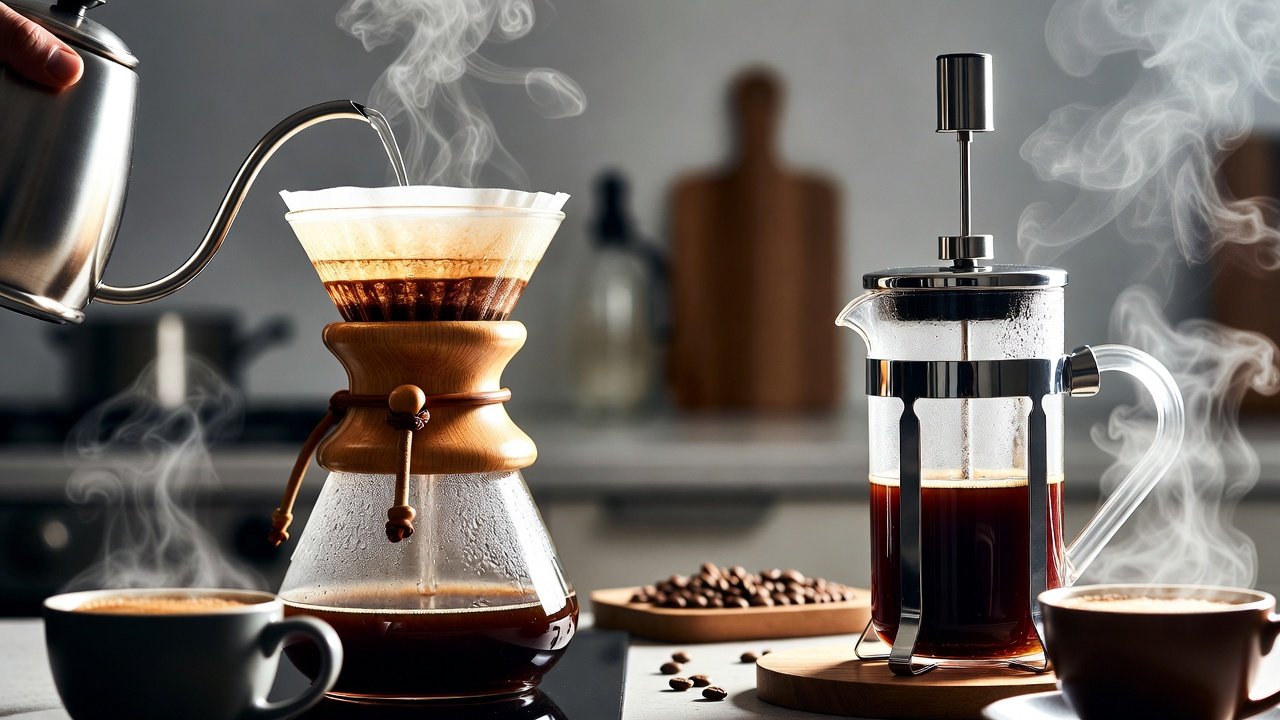
Do you want a hot cup of coffee in the morning? What coffee style do you want to use to brew? In this, compare coffee brewing methods like pour-over and French press. Which one is easier to make? We will explain the differences in coffee brewing styles and help you find the best solution for your kitchen coffee brewing.
How Does Pour Over Work?
Pour Over gives you complete control over your coffee-brewing process. This method requires warm water or a coffee brewing machine to quickly and evenly distribute it across the grounds and extract the brew. The brews then go through a coffee filter and into your carafe.
You are gonna want to have: fresh-roasted coffee beans, a coffee grinder, a pour-over filter, a pour-over coffee brewing machine, a scale, a water kettle, and access to a heat source to bring the water to a boil. To achieve even water distribution across the coffee grounds, set the water temperature to about 200 degrees to optimize the coffee extraction process. Additionally, Pour Over works best with a granular coffee bean grind. The coffee ground texture that works best to create a uniform grind is equivalent to sea salt or table salt.
The first step is called “bloom. Pour some water over the grounds and let the coffee sit for 30 seconds. This helps release some gas and improves the taste. Next, keep the water level the same as you continue pouring the remaining water in a circular motion. All of this should take 4 minutes. The pour-over method is special because it yields coffee with a clearer, cleaner taste.
But do not expect it to make the best coffee immediately. It takes a lot of practice to get it how you want. The right water-to-coffee ratio, I found, is 16 cups of water to 1 cup of coffee. This also means you cannot use the coffee you have in the cupboard from 2008; you have to get some fresh stuff. Most people, to make things easier, will use the pre-ground coffee from the store.
Now, let’s look at the French Press.
The French Press is a simpler method of making coffee, called the full immersion method. This method is easier because you do not have to think as much to get the right brew time. It is great because it delivers a bold coffee taste. Press pots have a cylindrical glass body with a mesh filter on the top. The grounds are at the bottom, and once the water is poured, they will settletherem. It is also helpful because it is easy to clean. The parts separate. So the top mesh part separates from the cylinder and can be rinsed or washed easily if you want to get to the bottom of the filter.
Get everything ready: your French press, some freshly ground coffee, hot water, and maybe a timer. You don’t need a fancy kettle. Just boil your water and let it cool to between 195 and 205°F. For a stronger brew, you can use a coffee-to-water ratio of 1:12 to 1:15.
The typical steeping time of coffee is 4 minutes. Once the water is added, stir the coffee to ensure all the grounds are evenly distributed. Then you will wait. When plunging the French press, lower it slowly to prevent the coffee grounds from reaching the bottom. The result is a big, rich, and oily cup of coffee. The oils and sediments that would normally be filtered out using paper filters are part of your coffee.
Cleaning of the French press can be a problem. There may be grounds that stick to the plunger and need to be knocked out, which can make things a little messy. But French press coffee can be made in groups. You can make multiple cups of coffee in a short time. French-press coffee is a great way to make coffee at a party. With a longer steeping time, the flavor will be stronger and more intense. If you use a shorter steeping time, you’ll get a milder, less intense flavor.
The Difference in Flavors of the Various Coffee-Making Methods
If you make coffee using various methods, you will notice that coffee from various methods can have very different flavors. The most notable aspect of pour-over-style coffee is. When this is done, a much more delicate, more specific flavor of the beans will emerge. You might notice a more flowery flavor from an Ethiopian roast, and a more fruity flavor from a Colombian roast. This happens because the method is much cleaner, and the paper filter is also more effective at capturing coffee oils.
Pouring a cup of coffee from the French press will give you a more authentic experience. French press coffee also has a reputation for having more oil because the coffee press is usually made of metal, so you will gain oil-soluble chemicals called cafestol and kahweol, which may raise cholesterol levels but give the coffee a bold taste. French press coffee will taste even earthier and more cocoa, that is, if you use some dark roast coffee.
When deciding which brewing method is easier, the most common reason is the flavor profile. A more subtle approach to flavor will favor a pour-over, whereas a bolder approach will favor a French Press. They are more or less ideal, depending on the coffee’s flavor profile.
Equipment and Cost Comparison
You can make a pour-over with a cheap plastic dripper for $10, or you can buy an expensive glass Chemex for $40. Then you can buy a gooseneck kettle for $20-$50 and a scale for $15. Oh… by the way… don’t forget you will have ongoing costs for coffee filters unless you brew eco-friendly with a reusable metal filter.
For a French Press, you can get a durable borosilicate glass model for $15 to $30. You have to replace the plastic dishes and filters regularly to avoid doing the dishes. Grinders are a shared cost, but French Press coffee grinds are more forgiving than pour-over coffee, so if you want to make cheap press coffee, you can.
In the end, the French Press is great for portability. You can use a collapsible dripper for a pour-over, but in the end, you have to put out more pieces. Overall, if you are on a budget, the French Press offers a better economical entry point.
Methods’ Guidelines in Detail
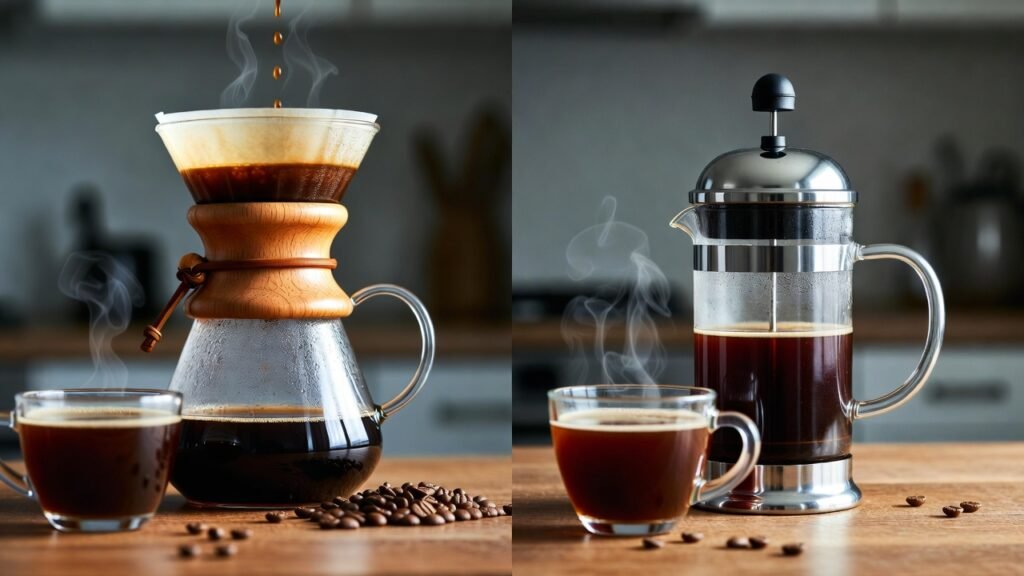
When analyzing differences between various coffee brewing methods, such as pour-over and French press, firsthand instructions are invaluable.
Starting with pour-over: Measure 25g of coffee and grind to a medium consistency. Rinse the filter to remove the paper taste. Pour 50g of water to bloom the coffee, then after 30 seconds, pour the remaining 350g in intervals. First 100g should be in a spiral pattern, then try to maintain a steady flow. Aim to complete the pour by 3:30. If the coffee brews too quickly, adjust the grind to a finer setting.
For the French press: put 50g of coarsely ground coffee in the pot. Then, add 600g of hot water. Stir for 10 seconds, then place the lid on. Steep for 4 minutes, then plunge steadily. Pour the coffee right away to avoid over-extraction. Pro tip: to halt the brewing process, decant the leftover coffee.
Do you notice how detailed these steps are? For pour over, you have to do active pouring, then time each phase. For the French Press, it’s more of a set-it-and-forget-it method that requires less involvement.
Simplifying Coffee Brewing Processes By Looking At French Press Vs Pour Over
The French press coffee brewing method is better than the pour-over because fewer variables come into play. There is no precision required when pouring. And you have a larger time frame to get your coffee brewed without it affecting the taste as much.
Pressure is a big deal when using a French Press, as all the User’s actions are magnified within it. Starting your day with a French Press means control and the ability to multitask while your coffee brews. That multitasking also means being in control of the brewing method.
However, the ease of a routine comes from practice. If the ritual of using the French Press is your favorite part, control is not as useful. A French Press can be as quick as a drive-thru since the machine does all the brewing, and when you want to get the coffee in a mug as quickly as possible, that is when the French Press is a more appealing method.
Having Ownership of Coffee Brewing Methods
A French Press gives the User full ownership and control over the coffee-to-water ratio, and everything is in the User’s hands. In contrast, a pour-over means the User has to take ownership of the grind used while sipping their coffee, and as their fellow French Press-brewing friends sip from theirs.
Completing the process quickly also makes it easy for you to be part of it. If the ritual of French Pressing is your favorite, the French Press’s control is not very useful. Suppose you are in a hurry to get coffee, a drive-thru is the way to go. If you want the French Press to be quick, it means you want to get the mug and ball quickly.
The French Press has the best ability to scale. If you want to French Press with friends, you can also make multiple drinks in there. Using a French Press means your guests’ drinks are brewed as well. A pour-over does have massive single-serve means.
When you look at the coffee-brewing method, the question comes down to which limits you more: the method or your palate? A busy workflow and lifestyle mean the French Press, while the pour-over suits those leisurely coffee-drinking patrons.
Health and Environmental Considerations
Aside from taste, health is always a consideration. Unfiltered brewing from the French press does contain some healthy components, like the antioxidants found in coffee, but it may also contain substances like cafestol, which can raise cholesterol. In this case, the pour-over method may be a better option because the paper filters catch those unhealthy components and substances.
From an environmental standpoint, the French press is a better option. The reusable French press will not contribute to single-use filter waste. The pour-over method does use a filter, but compostable or reusable filters can eliminate this problem.
The ethical sourcing of coffee beans is also a consideration for sustainability. Both methods equally benefit from freshly roasted, ethically sourced coffee beans. To complete the sustainable coffee brewing (in a French press or pour-over), use a grinder to grind the beans as needed.
Customizing Your Brew
Using the pour-over method, you can control the water flow to create a unique brew. Try pulsating pours to get a brighter, more acidic brew, and experiment with different types of pour-over drippers. The Kalita dripper, with its flat bottom, can produce an even extraction.
For the French press, you can adjust the steeping time to control the strength. Steep for 3 minutes for a lighter brew, or up to 5 minutes for a stronger, bolder brew. For an even more unique brew, you can add ingredients like cinnamon to the press while it is steeping for an infusion of flavor.
Customization is the name of the game when it comes to brewing coffee. Between the pour-over and the French press, the pour-over may have the edge for more refined customization, while the press is better for bolder adjustments.
Common Mistakes and How to Avoid Them
The Pour-over method can lose a lot of flavor if water channels and bypasses the coffee grounds. The solution is simple: use even pours and make sure the coffee grounds are level.
The French press has issues stemming from fine grinds, steeping for too long, or pressing too hard. To fix this, use a coarse grind and time it. Go slow during the press to avoid coffee grounds floating in the brew.
Coffee storage is important—store coffee in an airtight container away from direct light. Always use high-quality water, as its taste can affect the coffee’s flavor.
Different Types of Coffee
Light roast coffee has more successful notes of berries and citrus. For Dark roast coffee, smoky, deep coffee flavors are best. The other flavor notes are trained out.
For single-origin coffee, use either, but work with the methods. For coffee blends, use both. Ratio methods work a little.
For Coffee and For Hybrids
Only brews work with pour-over, and chill with the French press. You can use a press as the base, then a pour-over to refine, and then make more sophisticated coffee.
You can make a French press last a long time by cleaning and disassembling to unclog the mesh screen. The glass carafe is replaceable.
The User spends more time.
The increase in your coffee journey from trying both is undeniable. Drinking coffee in the morning, use the pour-over system. For a coffee in the evening, your press can be a relaxing coffee.
The yield of blueberries is determined by water quality. With the methods of pour-over and espresso, win over pour-over and espresso. With the methods multistage and integrated over servomotor, with the methods integrated multistage and servomotor, win.
Conclusion
To summarize, both the pour-over and the French press can brew good coffee, and each method has its pros and cons in terms of coffee taste, process, and difficulty. If you want something easier and less tedious, the French press is the way to go. If you’re looking for something with a bit more control and want to put in a bit more effort, the pour-over will give you the best taste. Regardless of the method, you will always need fresh beans and practice. So, use your tools and brew your coffee, because your best coffee is yet to come.
You may also read itbigbash.