
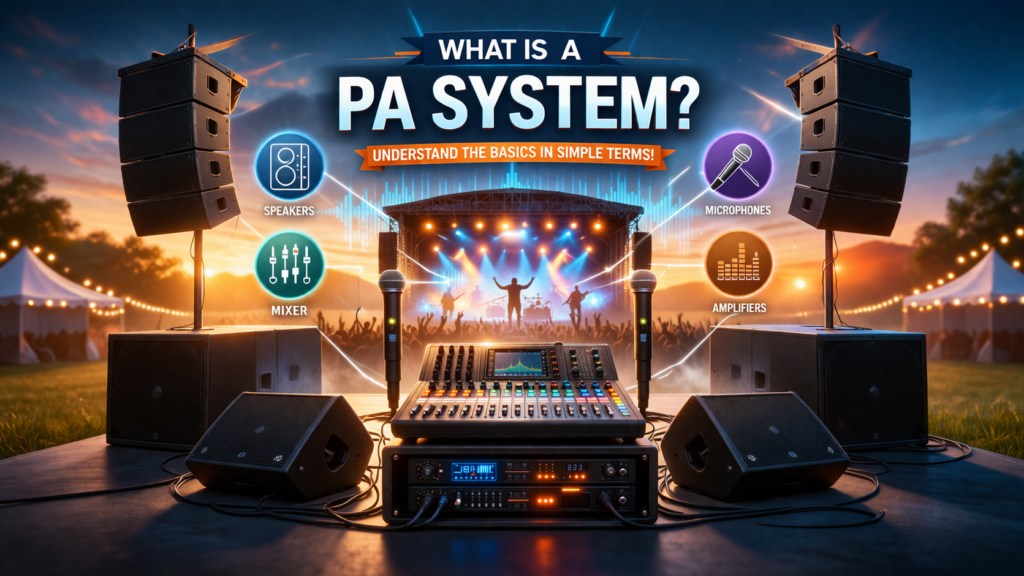
What Is a PA System? The Real-World Guide from a Sound Guy Who’s Fixed Every Mistake in the Book
Imagine you’re at your best friend’s wedding. The vows are about to commence, the string quartet is ready, and the officiant approaches the microphone. Instead of an officiant delivering touching words to the guests, there’s ear-piercing feedback, and half the guests instinctively cover their ears. I’ve been there. I’ve had to watch it in frustration, and I’ve been the one rushing to the back with duct tape and a prayer. It’s the kind of moment that inspires many to start searching for the answer to the question I get every week: What is a PAPA system?
You’re in the right place. After twenty-plus years of hauling gear into churches, clubs, corporate halls, and open fields, I’ve learned that a PA system isn’t just another piece of tech. It’s the invisible thread that elevates an event from enjoyable to unforgettable. In the next fifteen minutes, you’ll know what makes a PA system head and shoulders above the rest, what mistakes are going to cost you the night, and how to select gear that truly delivers. I will not waste your time. There will be no jargon nonsense, no sales pitches, just lessons from someone who has packed more vans than you have eaten hot dinners.
Fundamentally, what makes a PA system tick
When starting to understand what a PA system is, it is essential first to grasp the basic concept. The complete chain involves a quiet voice or instrument. It amplifies it to ensure everyone can hear it without distortion and to distribute the sound evenly across the entire audience area. However, understanding what a PA system is involves much more than a textbook definition. It’s more personal, it’s about feelings. The best systems go unnoticed, while the worst become a focus for all the wrong reasons.
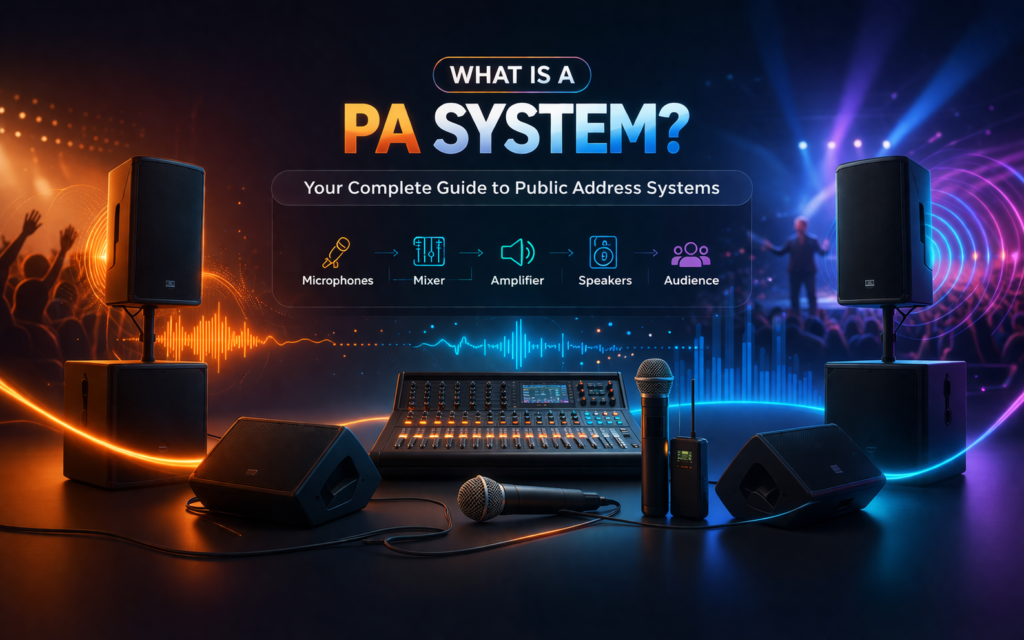
I recall that in 2004, my first paid DJ job was for a local band at a community hall. With two borrowed speakers and a mixer I didn’t know how to operate, I crashed the windows of a house two blocks away by the third song. I learned the hard way that a PA system is a combination of functional inputs, mixing, amplifying, and output. If one of these components is missing, the entire system fails.
Microphones and Inputs
Microphones and inputs are the front door. Dynamic microphones like the Shure SM58 are tanky, operate roughly, and still sound warm on stage. On the other hand, condenser microphones hate humidity, though they add a sparkle to guitar sound. Wireless microphones (with batteries) operate mid-solo and give the performer freedom, something that I have witnessed way more than I would like.
The Mixer
The brain of your mixer is where you balance all your elements. Most of the time, an eight-channel mixer is ideal. With monitors, effects, and click tracks for the drummer, you need a digital mixer with scene recall for a big mix. I still shiver thinking about a digital mixer saving a huge corporate awards show when the CEO decided to talk for 20 minutes off script. Scene recall lets me return to the previous settings in 3 seconds.
Amplifiers and Speakers
Amplifiers and speakers do the heavy work. Here is where the split between active and passive occurs. With active speakers, the amps are built in. Passive speakers require an external amp, but they offer greater flexibility in scaling. A PA system is only a bunch of expensive speakers if the speakers are not optimal.
Switching It Up with PA Systems: What’s Best for You?
Now that you know about PA systems, which type is best for you? For buskers and all sorts of events, like school or backyard weddings, a portable battery-powered unit like a Bose S1 or JBL EON is a lifesaver. I once conducted a 2-hour ceremony, and this system was the only source of power. It was worth every penny.
Line array systems, which are tall skinny boxes, are good for throwing sound further. These are not usually necessary unless you have 50 or more people. In a stadium, the PA system will use subwoofers to make the sound shake the concrete.
Column arrays have recently gained significant popularity. They are good for cutting setup time. I switched my church equipment to a pair of column arrays, cutting my setup time in half. First, the congregation recognized the added clarity I achieved.
How to Set Up a PA System Easily
Setting up doesn’t have to be so hard. Here is a great example to set up a PA system. This routine takes less than thirty minutes to complete. Even when half unconscious, I can easily complete this task.
Begin by placing the speakers correctly. Aim at the audience’s ears, not the sky. Make sure the speakers have appropriate stands so the tweeters are at least 8 feet above the ground. Clear sound is dead because the sound is bouncing off the floor.
Run your cables like a dangerous predator is after you. Tape every connection. I once lost an entire verse because a drunk uncle stepped on an XLR cable. Not going to let that happen again.
When shutting down, shut down the system in the reverse order to avoid nasty pops that can break the tweeter. Initiate the system in this order. Mixers first, then the processors, then the amps, which will be in the speakers.
Do a line check with each input. Go to every spot while someone is talking and walk. You will be able to find the location with the most dead spots and the most hot spots that need fixing, and you will not realize that you are the only person to complete this task.
Last, ring the system out. Raise the main fader slowly until that annoying screech is the main fader. Notching out the most annoying frequencies is a simple process that takes only 2 minutes and saves you a lot of time from future equipment damage. Do this simple step and keep your future self happy.
I have a set routine I have been using for as long as I can remember when working with a local band or a touring act. The routine has never failed me.
Real Stories Where the PA System Made or Broke the Night
Outdoor Jazz Festival, 2017. Ninety-degree heat, dust everywhere, and a promised 5,000 watts that turned out to be two underpowered boxes. By the second song, the lead’s vocals were gone. The promoter went mental. I took out a loan that year to buy full-active tops and subs for my trailer. The next festival I returned to sounded like a million bucks, and I got 3 more bookings right away.
Or the corporate gala, where the client was adamant that we use their “in-house system.” Translation: two ancient ceiling speakers and a mixer that’d been serviced in 1998. I set up my portable rig in my designated corner, blended the signals, and saved the CEO’s keynote. To this day, the CEO still sends me Christmas cards.
Those nights taught me that a PA system is never just about wattage. It is about matching the right tool to the right room, the right crowd, and the right moment.
Common Mistakes That Even Professionals Still Make
The first thing that comes to mind is feedback. However, other killers are more insidious. Running monitors are so loud that the band can’t hear the house mix. Not high-passing the vocal mic channels, letting rumble eat up valuable headroom. And putting subs in corners where they do nothing but create a muddy mess instead of a nice tight punch.
The most rookie of rookie errors? Buying based on price. Once, I did it. I got a cheap nameless system for a friend’s bar. Three months later, he had to pay to replace the system because the voice coils had cooked. He could have spent less money on a decent used Yamaha. I learned the hard way.
Pro Advice You Can Put to Use This Evening
Power should always be matched properly. An amp should deliver at least twice the continuous rating of your passive speakers. If you are under-powering, clipping will occur, and the drivers will fail faster than you can say “you’ve voided your warranty.”
Always bring extras. I learned the hard way when a venue with dirty power fried my mixer’s power supply in the middle of my set because I left my power conditioner at home.
Tune the space, not the system. If you’re serious, use a measurement mic and free software like Room EQ Wizard. After a quick calibration, everything will sound a lot clearer.
Please keep your gain structure clean. ‘Hot’ signals earlier in the chain and ‘low’ faders later always beat the reverse.
Where are PA Systems Moving?
Wireless everything, built-in DSP that auto EQs the space, and even AI ‘help’ that tweaks settings based on the number of bodies in the room. Battery life keeps improving, and lightweight carbon-fiber materials are making 100lb line arrays obsolete.
However, the core remains the same. What will always be a PA system comes down to 1 thing: helping the human voice and human instruments reach other humans without obstructing.
So when planning your next event, remember, a PA system is not just ‘gear’, it is your voice multiplied. Your audience will appreciate it.
Now make some real noise! I’ll be here in the mix cheering you on!
You may also read itbigbash.