
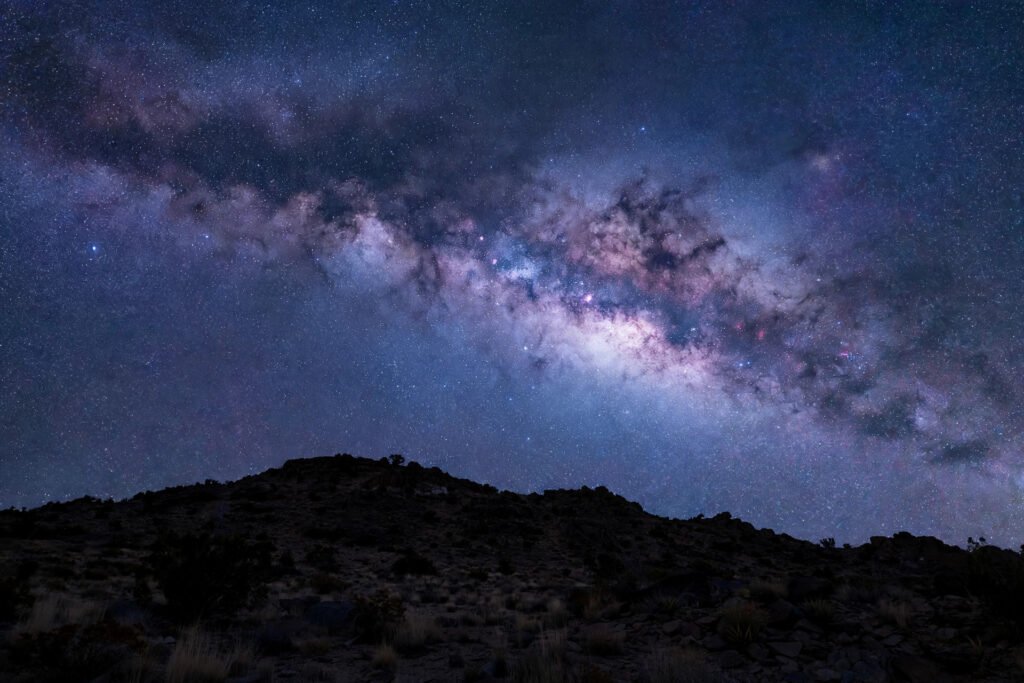
Astronomy 101: A Beginner’s Guide to the Night Sky
On a clear night, far from city lights, the sky does something no screen can copy: it makes you feel small in the best possible way. This astronomy 101 guide is for anyone who has looked up and wondered what they’re actually seeing — and wants to start understanding it tonight, not someday.
Here’s the short answer: beginner astronomy is mostly naked-eye stargazing. You learn a handful of bright constellations, how to tell planets from stars, and how to read the sky’s slow nightly motion. You don’t need a telescope, a degree, or any Latin. You need dark skies, about half an hour of patience, and a free star-map app. And if a Star Wars marathon is what got you wondering what a real starfield looks like, the Star Wars stories got the wonder right — this guide will help you find the real thing.
What Astronomy 101 Really Covers
Astronomy is the science of everything outside Earth’s atmosphere — planets, stars, galaxies, the whole lot. “Astronomy 101” is just the friendly nickname for its first chapter: what you can see with your own eyes, and what it means.
In practice, that means five things: recognizing the major constellations, telling planets from stars, understanding why the sky slowly turns overhead each night, reading star brightness and color, and knowing how light pollution and the Moon change what you can see. That’s the complete beginner syllabus — no equations, no telescope required.
It’s also worth knowing what it doesn’t cover yet. Astrophotography, cosmology, and deep physics come later. One of the kindest things you can do for yourself as a beginner is to keep this first stage small: your own backyard sky, learned well, teaches more than a dozen half-understood concepts.
Find Your Landmarks: Constellations and Star-Hopping
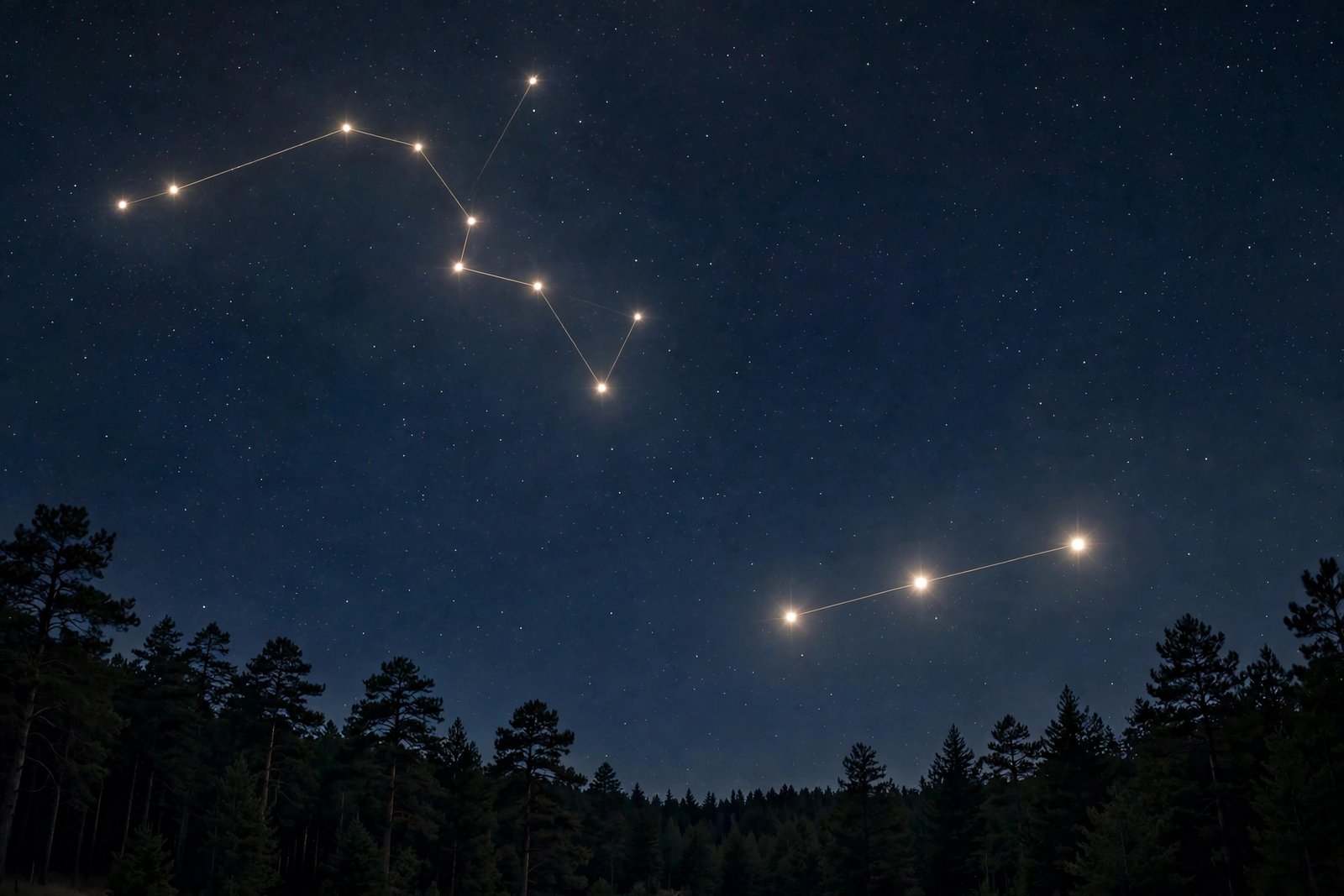
The International Astronomical Union divides the sky into 88 constellations, but you only need three to start: the Big Dipper, Orion, and Cassiopeia. Everything else can be found by hopping from these.
The Big Dipper isn’t technically a constellation at all — it’s an asterism, a recognizable pattern inside the constellation Ursa Major. The two stars at the front of its “bowl” point straight at Polaris, the North Star, which has guided travelers for centuries. Follow the curve of the Dipper’s handle and you “arc to Arcturus,” one of the brightest stars in the spring sky. That’s star-hopping: using one pattern to find the next.
Orion is the winter showpiece. His belt — three bright stars in a row — is unmistakable, and the fuzzy “star” in the middle of his sword isn’t a star at all. It’s the Orion Nebula, a stellar nursery where new stars are being born right now. Through binoculars it shows as a soft, glowing patch, and knowing what you’re looking at makes it genuinely thrilling.
Cassiopeia’s crooked W sits on the opposite side of Polaris from the Big Dipper, so between the two, one of them is always easy to find. In summer, look south for Scorpius and Sagittarius — that’s where the Milky Way runs thickest, and on a truly dark night you can see its cloudy band stretching overhead like spilled sugar.
Tell Planets, Satellites, and Meteors Apart
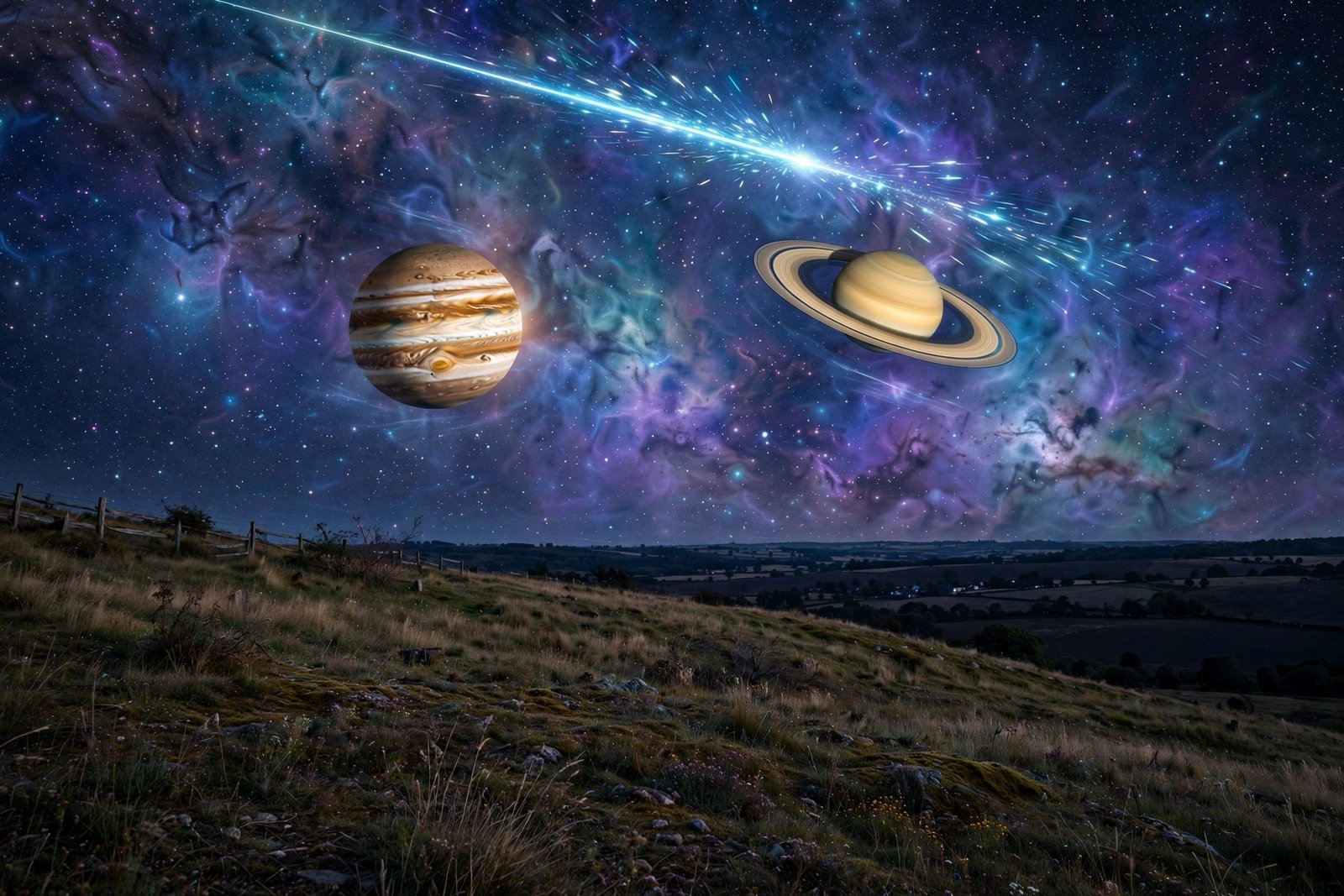
Once you know the landmarks, the next skill is identifying the things that move. Start with the twinkle test: stars twinkle because their pinpoint light gets bent by Earth’s turbulent atmosphere; planets, showing tiny disks, mostly shine with a steady light.
Venus is the show-off — at its brightest it reaches about magnitude −4.7, outshining everything except the Sun and Moon, and it never strays far from the Sun, so look for it near sunrise or sunset. Mars glows a distinct orange-red and changes brightness dramatically as Earth laps it in our faster orbit. Jupiter and Saturn are steady, cream-colored lights; on a clear night, binoculars will even show you Jupiter’s four largest moons shifting position from night to night — the same moons Galileo spotted in 1610.
Those slow, silent lights gliding across the sky in a straight line are satellites, not stars. Airplanes blink; satellites don’t. The brightest and most dramatic is the International Space Station, which can flare to outshine Venus for a few minutes as it crosses overhead. There are thousands of satellites up there now, launched by a booming commercial space industry — we even looked at the business of launching rockets in our guide to one of the new space companies.
And “shooting stars”? They’re not stars at all — they’re specks of dust burning up in the atmosphere, gone in a second or two. A true meteor streaks and vanishes; anything that moves steadily for a minute or more is a satellite.
The Only Gear You Actually Need
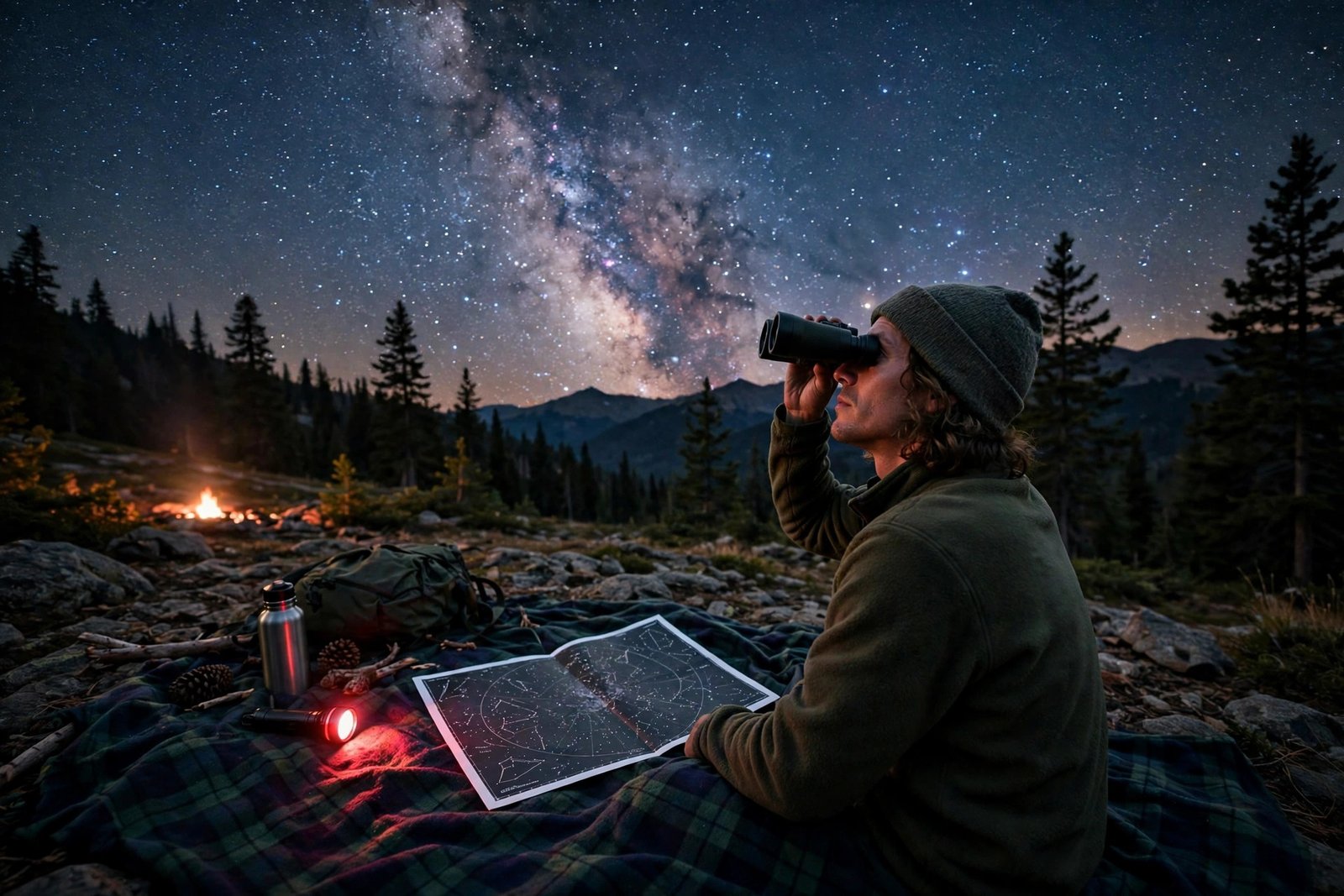
Your eyes come first, and they need about 20 to 30 minutes to fully adapt to the dark. This is real chemistry — the light-sensitive rods in your retinas need time to switch on — and one glance at a bright white phone screen resets the clock. Use a red flashlight or turn your phone’s screen red; red light preserves your night vision.
A free star-map app is the single best purchase you never have to make. Stellarium and SkyView use your phone’s GPS and compass to label exactly what’s overhead in real time. Hold the phone up, and the sky gets subtitles.
When you’re ready to spend money, spend it on binoculars, not a telescope. A 7×50 or 10×50 pair gathers far more light than your eyes, shows the Moon’s craters, Jupiter’s moons, and star clusters — and a decent pair costs less than a cheap telescope that will only frustrate you. A telescope makes sense later, once you know exactly what you want to look at.
The rest is comfort and planning: dress warmer than you think you need to, bring something to sit or lie on, and check two things before you go out — cloud cover and the Moon. A full Moon washes out faint stars, so the days around a new Moon are prime time. Autumn and winter give you longer, darker nights. If you can, drive even 20 minutes out of town; escaping the city glow transforms the sky. For finding truly dark spots and friendly company, NASA’s Night Sky Network lists local astronomy clubs that host public stargazing nights — beginners are always welcome.
Beginner Mistakes That Kill the Fun
Most people who quit astronomy in the first month quit for avoidable reasons. Buying a telescope first is the classic one — cheap scopes are hard to aim and show shaky, disappointing views. Start with eyes and binoculars.
Second: expecting Hubble photos. Nebulae and galaxies are breathtaking in long-exposure images, but through an eyepiece they’re faint gray smudges. That’s not failure — that’s the real, ancient light of those objects hitting your retina, and it feels different once you accept it.
Third: going out at full Moon and concluding the sky is boring. The Moon is a wonderful target itself — its craters and mountains are spectacular in binoculars — but it drowns out everything faint. Plan deep-sky nights for the new Moon.
Fourth: trying to learn the whole sky in one night. Pick one target per session — tonight the Moon, tomorrow Jupiter, next week Orion. Keep a small notebook: date, time, place, what you saw. You’ll be amazed how fast “I don’t know anything” turns into “there’s Saturn’s rings.”
Astronomy 101 FAQs
Do I need a telescope to start astronomy?
No. The Moon, five planets, the Milky Way, meteor showers, and dozens of constellations are all visible with the naked eye. Binoculars are the best first upgrade; a telescope only makes sense once you know what you want to observe.
Can I stargaze from a light-polluted city?
Yes, with adjusted expectations. The Moon, bright planets, and major constellations punch through city glow fine. Save the Milky Way and faint nebulae for trips out of town — even a short drive makes a dramatic difference.
Why do stars twinkle but planets don’t?
Starlight arrives as an almost perfect point, so turbulence in Earth’s atmosphere makes it dance. Planets show tiny disks, so the turbulence averages out and their light looks steady. It’s the quickest field test in astronomy.
What’s the difference between astronomy and astrology?
Astronomy is a science — it uses physics and observation to explain what objects in space are and how they behave. Astrology is a belief system claiming celestial positions influence human affairs. Same sky, completely different enterprise.
When is the best time to stargaze?
On moonless nights, after the sky is fully dark (usually an hour or more after sunset), with clear skies. Autumn and winter offer longer nights; summer offers the Milky Way’s bright core. Check the forecast and the Moon phase before heading out.
The Sky Was Always There
The strange thing about starting astronomy is realizing the show never stopped — you just weren’t looking. The same stars that guided ancient sailors are over your street tonight, and they’ll be there tomorrow, and in ten years when your notebook is full of crossed-out “firsts.” Step outside on the next clear night, find the Big Dipper, and start hopping. The universe has been waiting a long time for you to look up.