
How to Address an Envelope the Right Way: A Complete Guide
Learning how to address an envelope takes about two minutes, and it all comes down to placement: your return address goes in the top-left corner, the recipient’s address sits in the center, and the stamp goes in the top-right. Get those three positions right, write each address line in the correct order, and your letter will sail through the sorting machines and arrive on time.
That sounds simple — and it is — but most returned mail comes down to small details: a missing postcode, a stamp in the wrong corner, or an address squeezed so close to the edge that scanners can’t read it. This guide walks you through the exact layout, the correct line order, how US and UK addressing differ, and the mistakes that send mail straight back to you.
The basic layout: where everything goes on the envelope
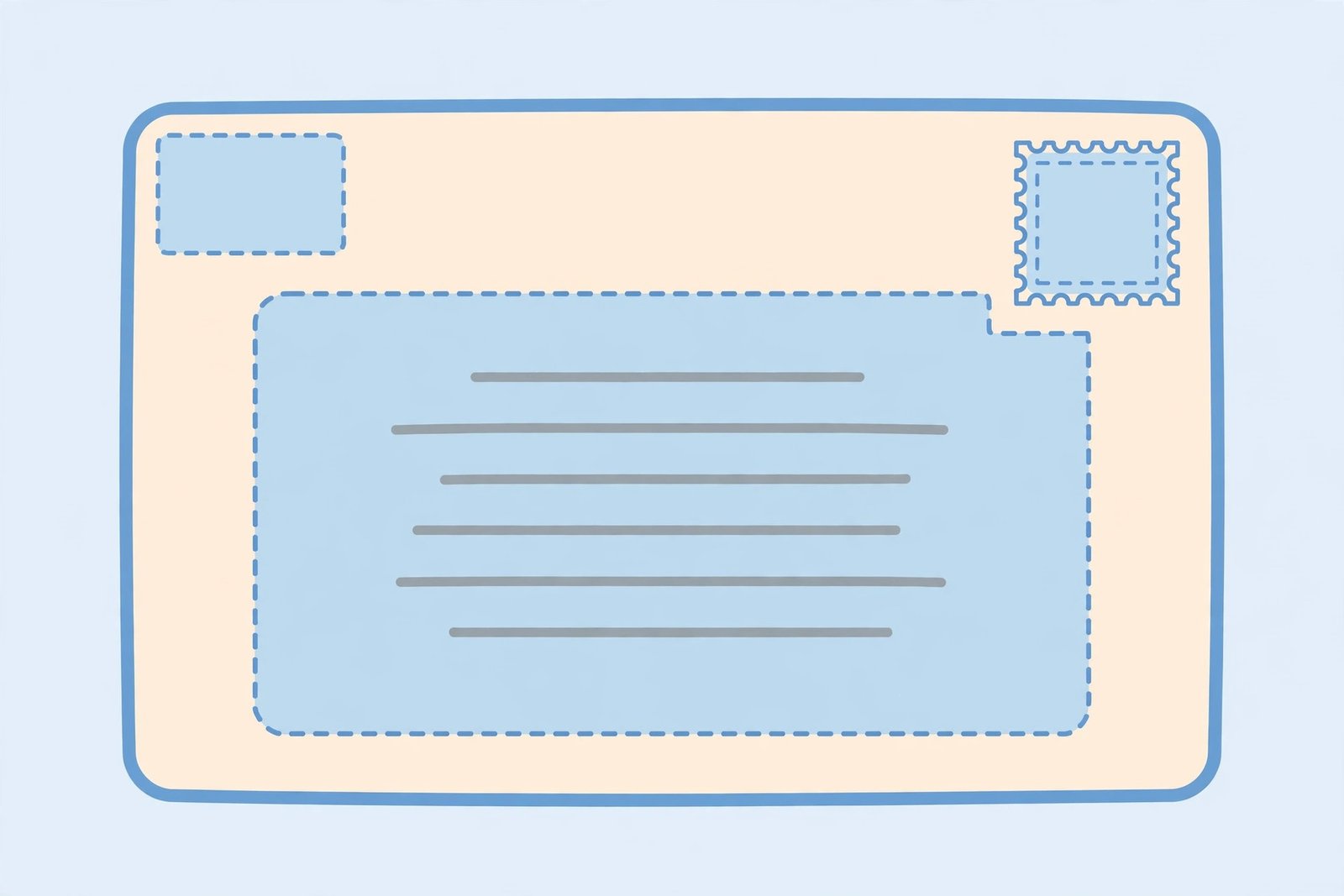
Every standard envelope has the same three zones, and postal machines expect them exactly here:
- Top-left corner: your return address (sender’s name and full address). This is your safety net — if the letter can’t be delivered, it comes back to you instead of disappearing.
- Center: the recipient’s address, written clearly and centered. This is the zone sorting machines actually read.
- Top-right corner: the postage stamp, with enough value for the letter’s weight and destination.
Leave the bottom-right area and the edges of the envelope clear. Sorting machines print routing barcodes there, and anything overlapping them can send your letter to the wrong place — or into a manual-sorting pile where it waits for days.
How to address an envelope step by step
Write the recipient’s address one element per line, in this order. This works for personal mail in both the US and the UK, with a couple of differences I’ll cover next:
- Recipient’s name — full name, plus a title if you want one (Mr., Mrs., Dr.). For formal letters, the full name looks more respectful than a first name alone.
- Company or department (business mail only) — the organization name, and the department or the person’s job title so it lands on the right desk.
- Street address — house or building number plus street name. Include the flat, apartment, or suite number on the same line if space allows, or on its own line right below.
- City, region, and postal code — town or city, then the state/province (for the US), then the ZIP or postal code.
- Country (international mail only) — the destination country, written in capital letters on the final line, in English.
A finished recipient address looks like this:
Dr. Sarah Malik
22 Willow Avenue, Flat 4
York, YO31 9QQ
Notice what’s missing: no commas and no full stops inside the address block. Postal systems prefer unpunctuated addresses because it makes machine reading more reliable.
How to address an envelope in the UK vs the US
This is the part most guides skip — and it’s the most common source of confusion when people learn how to address an envelope across borders. The two countries order their addresses differently:
UK addressing: The postcode gets its own final line and is the most important piece of the address — it pinpoints the street, often the exact building. There’s no state, and you don’t need to write “United Kingdom” on domestic mail.
Ms. Jane Hartley
The Beeches, 17 Mitre Drive, Clifton
York
YO31 9QQ
US addressing: The ZIP code sits on the last line along with the city and the two-letter state abbreviation.
Mr. John Carter
456 Elm Street, Apt. 12B
Chicago, IL 60616
The rule that holds everywhere: put the most specific sorting information — the postcode or ZIP — exactly where that country’s postal system expects it, and write it with extra care. A single wrong digit is the most common reason mail goes astray.
How to address an envelope for international mail
International letters follow the same structure, but with two additions. First, your return address is not optional — postal services need somewhere to send the letter back if it can’t be delivered abroad, so include your full address plus your country in capitals. Second, the destination country goes on the last line of the recipient’s address in uppercase English letters.
Addressing conventions vary by country, so if you’re posting somewhere with unfamiliar rules, check the Universal Postal Union’s international addressing guidance before sealing the envelope. The envelope itself has a long history, but international formatting is standardized enough that these basics cover most cases.
How to address a business envelope
Business mail needs one extra layer: making sure it reaches the right person inside the company, not just the right building. Add the recipient’s job title or department under their name — if the name and title don’t fit on one line, the title goes on its own second line. When you don’t know the person’s name, write “Attn:” followed by the department, for example “Attn: Accounts Department”.
Two conventions worth knowing: use “c/o” (care of) when the recipient can be reached through someone else — “c/o Ms. Lane” means Ms. Lane should pass it on. Use “FAO” (for the attention of) on company mail where you know the name but the envelope is addressed to the organization. And always do a quick search for the correct job title before posting — a letter addressed to the wrong role can sit in a mailroom for weeks.
Addressing envelopes for formal occasions
Wedding invitations, graduation announcements, and other formal mail follow the same layout but demand more polish. Use full names and proper titles, spell out words like “Street” and “Avenue” rather than abbreviating them, and never use labels — handwrite or have them professionally printed. For married couples, the traditional form is both names with titles (“Mr. Andrew and Mrs. Rebecca White”), though using both full names is equally correct. Children under 18 can be listed on the line below their parents’ names; anyone over 18 gets their own invitation. Getting everyday etiquette details like this right sets the tone before your guests even open the envelope.
7 mistakes that get envelopes returned
If you’re wondering how to address an envelope so it never bounces back, avoiding these errors is just as important as the layout itself:
- Wrong or missing postal code. This is the number one cause of undelivered mail. Double-check every digit.
- No return address. Without one, an undeliverable letter has nowhere to go — it simply vanishes.
- Address written on the back flap. Always use the front of the envelope; the back is invisible to sorting machines.
- Address too close to the edges. Keep clear margins on all sides so scanners can read the full address.
- Illegible handwriting. Print rather than using cursive or decorative scripts, and use dark ink — black or blue — on a light envelope. Typed labels are fine for business mail. As with putting pen to paper in general, clarity beats style.
- Stamp in the wrong corner. Top-right, every time. A stamp elsewhere can confuse automated processing.
- Forgetting the country on international mail. Without it, your letter may loop through domestic sorting before anyone figures out where it’s meant to go.
Quick answers to common questions
Should I include a title like Mr. or Dr.?
It’s polite, especially for formal correspondence, but not required for delivery. Use whatever title the recipient uses themselves — guessing wrong can be worse than using none.
Can I skip the return address?
You can, and the letter will still be posted, but if anything goes wrong there’s no way for it to come back to you. Always include it for important or international mail.
Is it okay to abbreviate?
Standard, widely recognized abbreviations (St, Ave, Apt, and US state codes) are fine and postal systems expect them. Spelling everything out is safer for formal or wedding mail, where abbreviations look sloppy.
The bottom line
Mastering how to address an envelope properly comes down to three habits: put each block in the right place, write the lines in the right order, and proofread the postcode. Do that, and your mail gets where it’s going — with the right impression arriving before the letter is even opened.